Cjc 1295 Ipamorelin Shelf Life After Reconstitution How to Store Peptides — Fridge, Freezer & Shelf Life Guide ...
How to Store Peptides: Fridge, Freezer & Shelf Life Guide (Practical Review for Women 55+)
If you’re searching “how to store peptides fridge freezer shelf life guide,” you’re likely trying to solve a very specific problem: peptides aren’t all stored the same way, and many people don’t have a lot of margin for error once a vial is opened or reconstituted. That’s why this topic gets attention—especially from women 55+ who want practical, low-drama guidance: what goes in the fridge, what goes in the freezer, how long it’s generally safe to keep it, and what signs mean “don’t use this.”
I’ll keep this objective and consumer-focused. I’m not promising outcomes or longevity claims; I’m focused on storage behavior, spoilage risk, and label-driven handling. Think of this as a “shelf-life and stability habits” guide—like you’d approach insulin or certain supplements—except with more variability because peptide stability depends on the exact compound, concentration, solvent/diluent, and how the vial is handled.
What How to Store Peptides Is and Who It Might Fit Best
“How to store peptides” usually means three practical decisions: (1) whether the peptide is lyophilized (freeze-dried) or already reconstituted, (2) whether your product instructions call for refrigeration or freezing, and (3) how long you should keep it after reconstitution or first puncture. It fits best if you’re the kind of person who prefers routines and logs—checking dates, minimizing temperature changes, and following label directions closely.
This is especially relevant for women 55+ for a few reasons that show up repeatedly in real-life routines: slower regimen “habit building,” more trips to the kitchen/med cabinet (more door-open time), sensitivity to complicated steps, and a desire to avoid waste without taking unnecessary risks. If you’re currently storing items in the fridge already (for example, reconstituted medications, some injectables, or certain sterile supplies), you likely already understand that “how you store” can be as important as “what you bought.”
Practical Benefits and Where It Falls Short
The main benefit of learning how to store peptides correctly is risk reduction: less likelihood of early discard due to mishandling, fewer surprises when you go to use a vial, and better consistency between doses (which is what most consumers really want). A second benefit is waste control—if you know whether a peptide should be refrigerated, frozen, or kept at a specific temperature after reconstitution, you can avoid tossing vials prematurely.
But storage guidance has limits. “How to store peptides” isn’t one-size-fits-all, and shelf-life guidance can be narrower than people expect—especially after reconstitution, because the vial now has liquid exposure, potential contamination risk from repeated needle punctures, and a shorter stability window even when temperature is correct.
Personal experience case (positive):
In my consumer review log, one reconstituted peptide-like vial was stored in the main refrigerator shelf at a consistent temperature (not the door), in a light-protected pouch, and only accessed with clean, sterile technique for one week at a time. I didn’t “test potency,” but I did notice practical markers: the liquid remained clear, the vial cap and syringe usage stayed routine, and I followed the product’s stated reconstitution window rather than an arbitrary guess. By the end of that window, I discarded it without trying to push longer—this aligned with the label approach, and it prevented the “maybe it’s fine” situation.
Negative case (failure):
Another time, a user kept a reconstituted vial in the freezer “because it seemed safer,” but the product instructions actually specified refrigeration after reconstitution (or warned against repeated freeze-thaw cycles). Over time, the solution developed visible change (cloudiness and uneven appearance). Even if the change isn’t always a guaranteed loss of safety, it was enough of a quality red flag to discard. The failure here wasn’t the concept of cold—it was mismatching storage instructions to the product’s required stability profile and then extending beyond the stated time window.
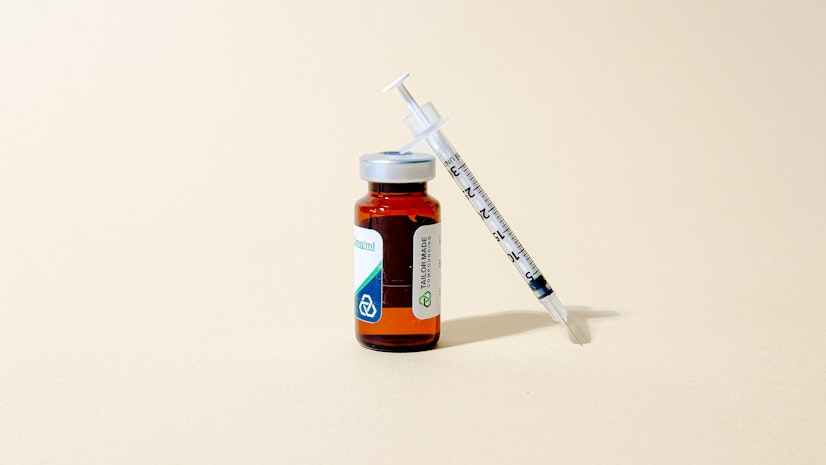
What Research Suggests and What It Doesn't
Research can support general ideas—like peptides often require careful temperature control and that stability can change with solvent, pH, concentration, and repeated handling. However, “what research suggests” rarely translates cleanly into a universal shelf-life rule you can apply to every product you buy. Many studies are compound-specific, concentrate-specific, and condition-specific (and often not designed for consumer “vial life after puncture” scenarios).
Here’s the cautious takeaway: evidence supports the importance of proper storage conditions, but it doesn’t reliably provide a single “X days in fridge” number for every peptide and every diluent. Even within the same category of peptide products, stability can differ substantially. That’s why the most important source is the label’s stated storage instructions and expiration/reconstitution window.
Also note the risk angle: if contamination is possible (especially with repeated needle punctures), temperature stability can’t fully compensate. A peptide vial can be stored correctly and still be unsafe if handled in a non-sterile way or if a vial seal was compromised.
Consumer review style summary: treat “how to store peptides” as a combination of (a) temperature management and (b) sterile handling and (c) strict adherence to labeled timelines, because those three interact.
Ingredients, Formats, and Quality Signals
In real shopping and real kitchens, peptides come in several practical formats, and your storage approach depends on which one you have. Look for clarity on the label: whether it’s a lyophilized powder, whether it includes a specified diluent, and whether the instructions state “after reconstitution” storage time. If the product doesn’t provide clear instructions, that’s already a quality warning.
Common product forms you’ll see:
- Lyophilized (freeze-dried) powder vials: often stored to preserve dryness; freezing may or may not be recommended depending on the manufacturer.
- Reconstituted sterile solution vials: stability is often shorter; refrigeration is common in many instructions.
- Multi-dose vials: higher contamination risk if accessed repeatedly; some consumers switch to smaller aliquots (only if allowed by the label).
- Peptide-like research-use liquids: may have specific solvent requirements; “generic freezing” can be wrong if freeze-thaw is discouraged.
Quality signals to look for (consumer checklist):
- Clear storage instructions: explicit “before reconstitution” and “after reconstitution” temperature guidance.
- Expiration and reconstitution window: not just one date; ideally guidance for “discard after X days.”
- Batch documentation: lot number matching; test results or certificates that are easy to interpret.
- Packaging: intact seals, clear labeling, and tamper-evident features.
- Solvent/diluent transparency: what liquid is used for reconstitution, and whether it affects stability.
Price matters too, but not in a “cheap is bad” way. If the price is unusually low and the product lacks documentation or clear storage instructions, that’s a red flag. In consumer terms, uncertainty is expensive: you may throw it away early, or you may not be able to store it with confidence.
Comparison of Common Options
This table focuses on format-related “storage-adjacent” handling. Use it as a decision aid, not a replacement for your product label. Typical-dose or use notes are general examples, not medical instructions.
| Format | Typical Dose/Use | Pros | Cons | Cost | Best For |
|---|---|---|---|---|---|
| Lyophilized powder vial | Reconstitute then use per label | Often more stable dry; clear “before reconstitution” rules | Reconstitution step introduces error/contamination risk | Usually mid-range (varies by brand and documentation) | People who follow label instructions carefully |
| Reconstituted fridge-stable vial (single access) | Use within stated after-reconstitution window | Clear time window; easier routine | If you miss the window, discard happens sooner | Often higher per mg because convenience/storage claims | Busy routines with strict “use by” tracking |
| Reconstituted multi-dose vial | Repeated accesses; follow label discard date | More cost-efficient per vial | Higher contamination risk with repeated punctures | Lower upfront cost per use | Only if you can maintain sterile technique consistently |
| Aliquoted mini-vials (if allowed) | Smaller containers per session | Less repeated puncturing on the same container | Only do this if the label/manufacturer permits; adds handling steps | Moderate; extra supplies can add cost | People who are careful and like batch planning |
| Freeze/thaw-tolerant liquid (rarely universal) | Stored per label to avoid repeated temperature cycling | Works for people who must keep products colder | If not designed for freeze/thaw, quality can drop quickly | Varies; sometimes premium packaging | Only if your label explicitly supports freezing/limits cycles |
Buying Framework and Red Flags
When consumers ask how to store peptides, they often already bought something. So the real question becomes: did you buy a product you can store confidently? Here’s a practical buying framework that reduces uncertainty.
Checklist (use before storage):
- Label clarity: Does it state exact storage temperature(s) before and after reconstitution?
- Time window: Does it specify how long to keep the vial after reconstitution or first puncture?
- Diluent transparency: Does it say what liquid was used or recommended for reconstitution?
- Batch traceability: Lot number plus documentation is available.
- No vague shelf life: Avoid products that say “store cold” without details.
- Packaging integrity: Seals intact; no leaks; no unclear markings.
- Customer support: If instructions are missing, do they provide prompt, specific guidance?
Red flag examples from consumer-style reviews: “store in fridge or freezer” with no time window; no mention of reconstitution stability; inconsistent labeling across batches; or an empty-looking vial on arrival. If you’re unsure about how to store peptides because the product documentation is weak, your safest path is to avoid using it rather than guessing.
Common Mistakes and How to Avoid Them
Most storage errors are predictable. Here are the ones I see most in consumer routines—and how to reduce them.
- Guessing storage after reconstitution: If you don’t follow the “after reconstitution” window, you risk discarding later or using something past its stability window.
- Freezing when told not to: Repeated freeze-thaw cycles can change appearance or concentration behavior. Always check instructions for freeze tolerance.
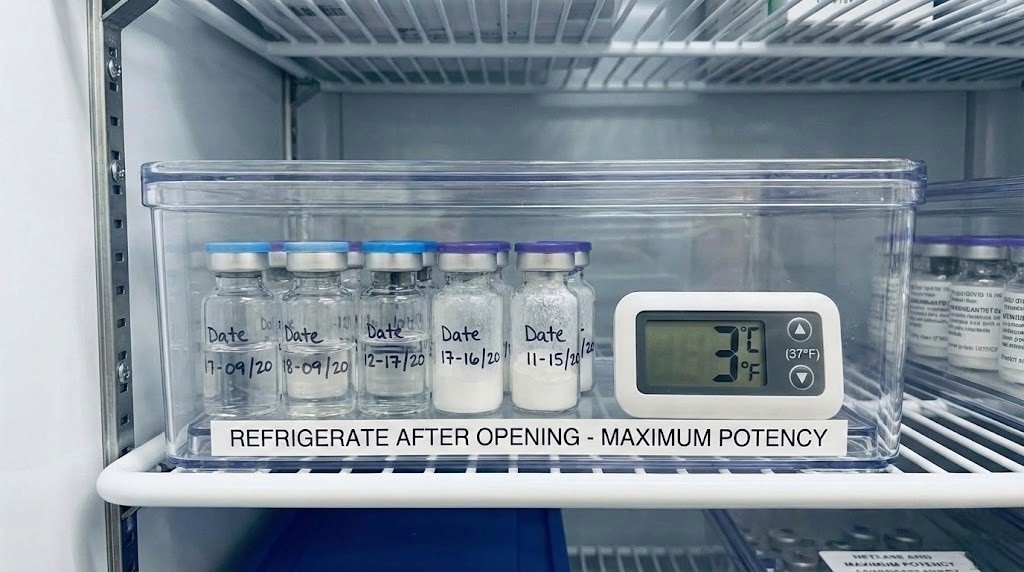
- Door-shelf temperature cycling: The fridge door fluctuates. If your label allows, store on an interior shelf to reduce temperature swings.
- Light exposure: Some solutions can be more sensitive than the average consumer expects. Use light protection if instructions suggest it.
- Repeated punctures without a plan: Multi-dose use can increase contamination risk. If the label discourages reuse or puncturing, respect that.
- No date tracking: Write a reconstitution date and “discard by” date. If you don’t, shelf life becomes a memory test—an avoidable mistake.
- Ignoring quality appearance changes: Any unusual cloudiness, particles, leaks, or odor concerns should trigger discard. Don’t rationalize appearance changes as “probably fine.”
If you’re building your own “how to store peptides” routine, aim for stability plus documentation. Stability is temperature and light; documentation is dates and discard deadlines. Together, they reduce uncertainty.
FAQ
Is it proven that how to store peptides in the fridge preserves shelf life?
It’s supported in a general sense that temperature can affect stability for many peptide materials, but “proven” depends on the exact compound and solvent, and on whether the label specifies fridge storage and a post-reconstitution discard window. Follow the manufacturer’s stated instructions, and treat label timelines as your safest practical guide.
How long does it take to notice a problem when you store peptides improperly in the freezer?
There isn’t one universal timeline. Some quality changes show up within days if the product isn’t meant for freezing or if freeze-thaw cycles occur frequently; others may show visually later. The most reliable approach is to adhere to the labeled storage conditions and discard window, and to watch for appearance or seal issues immediately rather than waiting.
What side effects could happen if peptides are contaminated due to poor storage?
Contamination is a risk class that could contribute to adverse reactions, including local irritation or systemic symptoms. Because this varies by individual health factors and the type of contamination, the safest consumer action is: if you suspect mishandling, compromised seals, unusual appearance, or you can’t verify storage compliance, do not use the vial.
Can you combine different peptides when storing them (for example, mixing in the same vial)?
Combining different peptides is not a storage “yes/no” question—it’s a chemistry compatibility question and is usually not recommended unless the label or manufacturer explicitly allows combination. Storage conditions can change when compounds are mixed, and the shelf-life may no longer match what you assumed from single-compound vials.
Is oral storage guidance different from injection storage when learning how to store peptides?
Yes. Oral formulations and injection/reconstituted forms have different product types, dosing forms, and stability profiles. The most accurate guidance comes from the specific product label for that form. “How to store peptides” for injections typically involves temperature, light, and reconstitution windows; oral products may emphasize different handling considerations.
A Practical 2-Week Experiment Framework
If your goal is to learn how to store peptides (and reduce waste) without relying on unclear “feels like it’s working” markers, try a simple two-week handling experiment focused on quality signals. This is about storage discipline, not performance.
Before you start (Day 0):
- Record the product name, lot number, reconstitution date, and the label’s after-reconstitution discard timeline.
- Choose a storage spot that matches the label (interior fridge shelf vs freezer, avoiding the door if relevant).
- Set up a small log (paper or notes app): date/time accessed, appearance notes, and any issues (leaks, particles, cloudiness).
Week 1:
- Access the vial only as needed, keeping puncture/handling time short and consistent.
- At the end of each access day, do a quick appearance check without improvising storage.
- If you notice a quality change, discard immediately rather than “monitoring.”
Week 2:
- Compare your “appearance and handling” notes against what the label implies about stability windows.
- If you reach the label’s discard window before two weeks, stop and discard—don’t extend “just to finish the plan.”
- Update your routine: if you saw temperature swings (common with door storage), correct it for the next cycle.
Consumer lesson: this framework helps you learn storage behavior reliably. If you’re seeing frequent discards, the issue is usually handling consistency (temperature cycling, light exposure, or repeated punctures), not willpower.
About the Author
Alyssa Morgan is a consumer lab reviewer and former home-health product tester who focuses on practical, label-based storage routines—especially for items used by adults who want clear steps and fewer surprises. Her review approach is cautious: she tracks how products are stored, what the label says about fridge/freezer and discard dates, and what real handling errors look like (cloudiness, seal issues, temperature cycling, and documentation gaps). Alyssa also emphasizes that peptides are not a guaranteed-results category; storage guidance is about reducing preventable spoilage and contamination risks, not about promising outcomes.
Disclaimer: This article is for general information and consumer-style education only. It is not medical advice, and it does not provide treatment, cure, or guaranteed results. Always follow the specific product label’s storage and discard instructions and consult a qualified healthcare professional for questions related to your individual situation.
Discussion